
White-shouldered bumble bee
Bombus appositus
Nesting Preference
Nests have been recorded underground, at the ground surface, and above ground; it is not exclusively an underground nester.
Active Time of Year
Spring through summer. Activity starts later in cooler, higher-elevation locations, so mountain observations do not provide a fixed calendar for the valley.
Identifying Characteristics
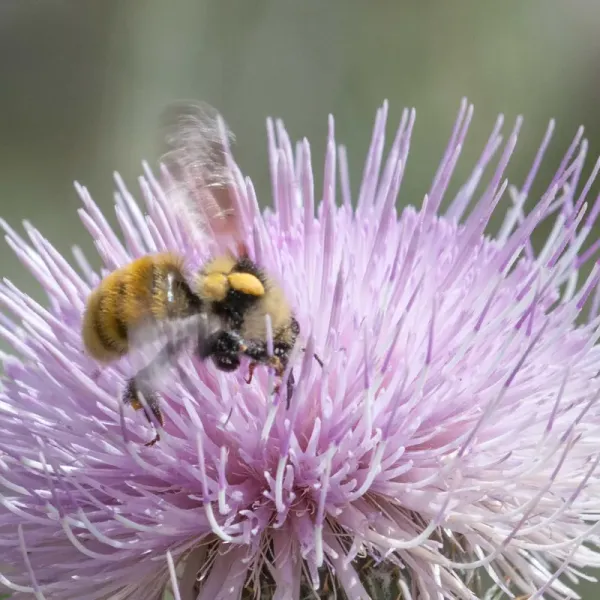
A large, long-faced bumblebee. Queens and workers have pale facial hair and pale hair at the front of the thorax, contrasting with a black band between the wings. Much of the abdomen is straw-yellow to brownish orange. The sides of the thorax are mostly black, so the bee is not uniformly pale.
Fun Fact
This is a long-tongued bumblebee, a useful trait for reaching nectar in deep flowers.
Also called the mountain bumble bee, this species occurs in western grasslands, fields, and mountain meadows. Despite the alternate name, it is not restricted to high elevations: OSU researchers recorded it foraging in Willamette Valley blueberry and red clover fields.