
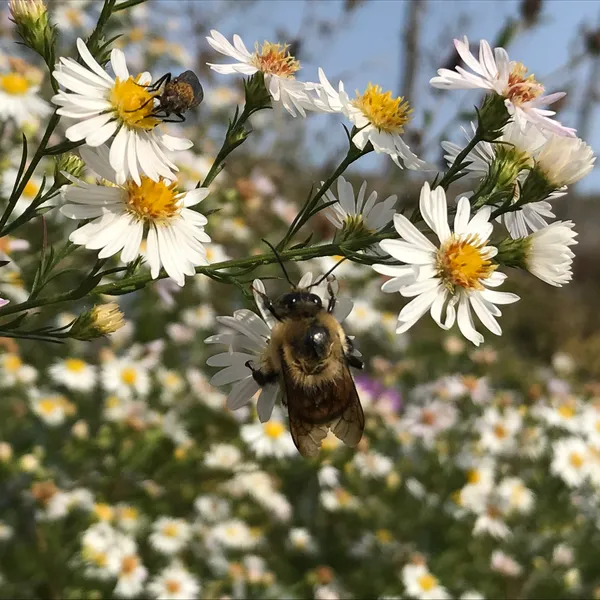
Brown-belted bumble bee
Bombus griseocollis
Nesting Preference
Often nests at the ground surface in sheltered cover; underground nests are also reported.
Active Time of Year
Spring through summer and sometimes into fall. Regional records differ, so dates from eastern North America should not be treated as a fixed Oregon schedule.
Identifying Characteristics
Queens and workers have a black face, a yellow thorax with a small dark spot between the wings, and a yellow first abdominal segment. Workers often have a brown crescent on the second segment, but this area can be yellow in queens. The remaining abdomen is mostly black. The brown belt is useful when present, but it is not universal.
Fun Fact
In a laboratory study, young males helped warm pupae, the developing bees inside cocoons. They wrapped themselves around the cocoons and transferred body heat to them.
Brown-belted bumblebees occur across much of the United States, including western Oregon. OSU studies documented them in Willamette Valley blueberry and red clover fields. They visit many kinds of flowers in open habitats, including farmland, gardens, parks, and wetlands.