
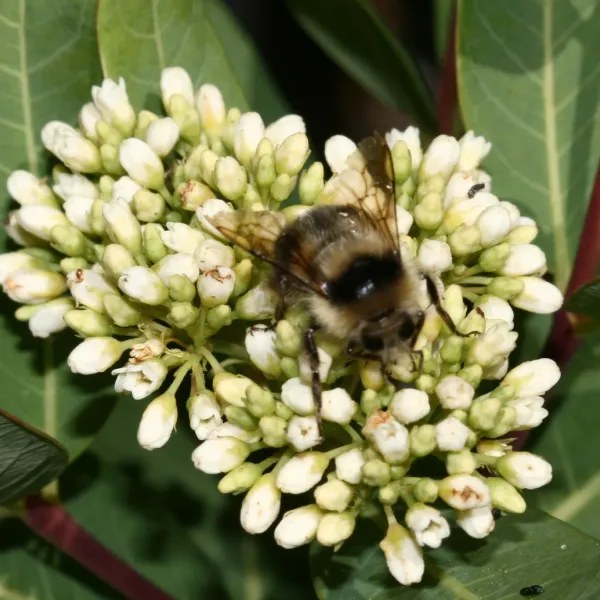
Black-tailed bumble bee
Bombus melanopygus
Nesting Preference
Nests in underground cavities and also in sheltered above-ground sites, including bird boxes and building insulation.
Active Time of Year
One of the earlier species to appear, beginning in late winter or early spring in mild areas. In the Willamette Valley, colonies often finish their season before the main summer red clover bloom.
Identifying Characteristics
Queens and workers have mixed yellow and black hairs at the front of the thorax, giving it a cloudy appearance. Many Oregon bees have orange-red hair on the second and third abdominal segments and a darker tail. A form with black middle segments also occurs, especially farther south. A black tail alone is not enough to identify this species.
Fun Fact
The red-banded and black-banded forms were once treated as separate species. Genetic and breeding studies helped establish that they belong to the same species.
Black-tailed bumblebees visit a wide variety of flowers, including currants, willows, and blueberries. Their early season makes spring flowers especially relevant when looking for these bees. Color varies across their range, so compare several features rather than relying on the common name.