
Common Buckeye
Junonia coenia
Adults Fly
July–October (often peaking August–September).
Eggs Laid
July–September (when adults are most common locally).
Larvae Active
July–October.
Overwintering
Does not reliably overwinter in the Willamette Valley due to freezing sensitivity; many individuals arrive via seasonal movement.
Conservation (NatureServe)
G5 (Secure)
Widespread; abundance in Oregon can vary year to year because many are migrants.
Caterpillar Host Plants (Willamette Valley natives)
- Common monkeyflower (yellow seep monkeyflower) Erythranthe guttata — Native; thrives in seeps and wet edges—reported host genus (Mimulus/Erythranthe).
- Woolly plantain Plantago patagonica — Native plantain of dry, open ground.
- California plantain Plantago elongata — Native annual plantain of open, seasonally moist sites.
Favorite Nectar Flowers (Willamette Valley natives)
- Douglas aster Symphyotrichum subspicatum
- Canada goldenrod Solidago canadensis
- Gumweed Grindelia integrifolia — Native composite; strong late-season nectar.
- Common yarrow Achillea millefolium
- Oregon sunshine Eriophyllum lanatum
What the Caterpillars Eat
Leaves of host plants in Plantaginaceae/Phrymaceae—locally, monkeyflowers (Erythranthe/Mimulus) and native plantains (Plantago) are good candidates.
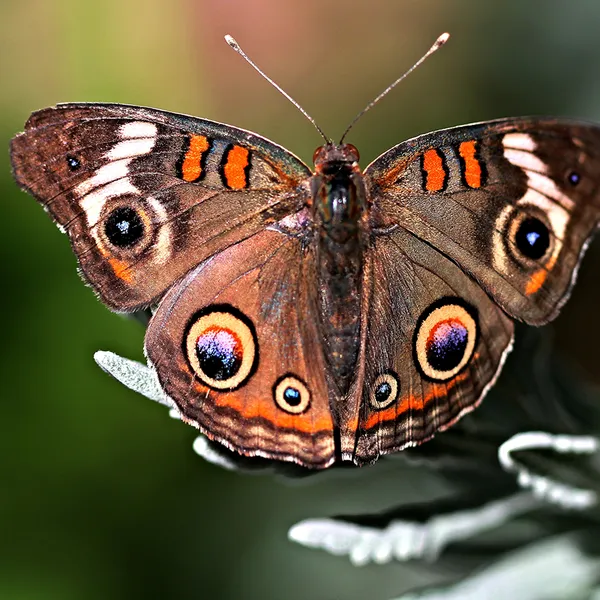
The Common Buckeye looks like it was designed by a comic-book artist: rich brown wings with bold orange bars and four dramatic eyespots. In the Willamette Valley it’s most often noticed in late summer and early fall, especially in open, sunny places with low vegetation and a bit of bare ground.
Buckeyes love to perch—on trails, rocks, fence posts—then burst into flight and circle back to the same spot. Adults nectar on a wide range of flowers, especially composites like asters and goldenrods.
This butterfly is sensitive to freezing, so it typically doesn’t make it through colder winters here. In many years, what we see in Oregon represents seasonal movement from warmer regions, with breeding concentrated where host plants are abundant.
Fun Facts
- Those big eyespots aren’t just for show—they can startle predators, and the butterfly will often flash them when disturbed.
- Buckeyes commonly return to the same perch repeatedly, which makes them a fun species for close observation and photography.