
Mourning Cloak
Nymphalis antiopa
Adults Fly
March–April (overwintered adults) and June–October (new adults).
Eggs Laid
April–May (shortly after adults emerge from winter shelter).
Larvae Active
May–June (often in noticeable groups on host branches).
Overwintering
Overwinters as an adult in protected crevices (bark, wood piles, rock cracks, outbuildings).
Conservation (NatureServe)
G5 (Secure)
Widespread; local declines can occur where host trees are removed from waterways.
Caterpillar Host Plants (Willamette Valley natives)
- Scouler's willow Salix scouleriana
- Pacific willow Salix lucida ssp. lasiandra
- Black cottonwood Populus trichocarpa
- Sitka willow Salix sitchensis
Favorite Nectar Flowers (Willamette Valley natives)
- Tall Oregon grape Mahonia aquifolium — Early spring blooms; great ‘wake-up’ nectar.
- Red-flowering currant Ribes sanguineum — Early spring nectar; hummingbird favorite too.
- Osoberry Oemleria cerasiformis — Very early bloom; supports early pollinators.
- Thimbleberry Rubus parviflorus — Spring nectar in woodland edges.
- Common yarrow Achillea millefolium — Summer nectar when they switch to flowers.
What the Caterpillars Eat
Leaves of willows (Salix) and cottonwoods (Populus); feeding can look dramatic but hosts usually recover.
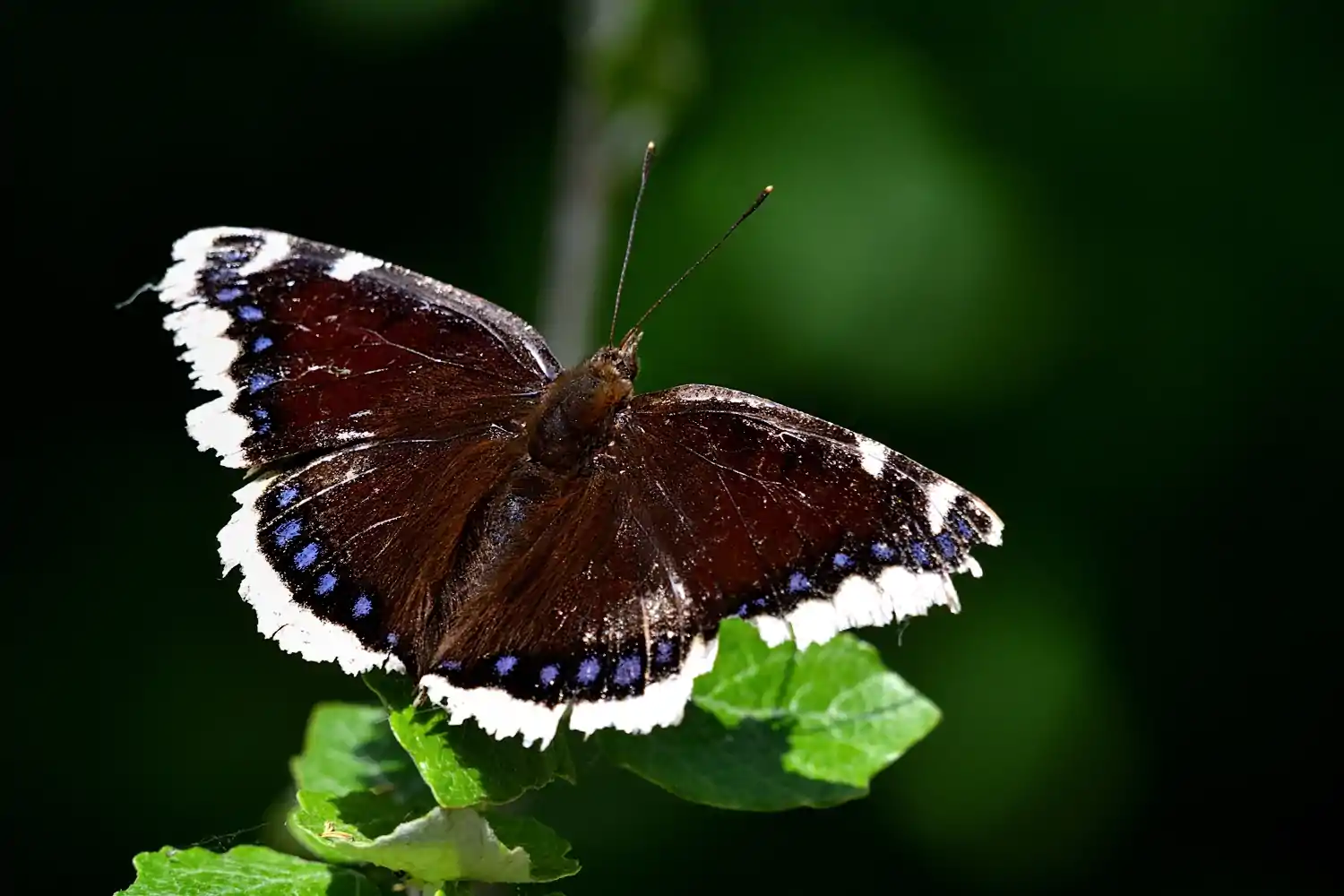
If you spot a large, dark butterfly cruising through late winter sunshine, there’s a good chance it’s the Mourning Cloak. Its deep maroon wings are trimmed with a pale yellow edge and sprinkled with iridescent blue spots—like stained glass at dusk.
This species is famous for its timing: it overwinters as an adult, tucked into bark crevices or other sheltered places, then reappears early in spring when very few butterflies are flying. Because early flowers can be scarce, adults often sip tree sap and feed on fermenting fruit.
Caterpillars feed in groups on native trees and shrubs—especially willows and cottonwoods—and later the fresh adults emerge in early summer. In good years, Mourning Cloaks can be among the longest-lived butterflies you’ll meet in Oregon.
Fun Facts
- Mourning Cloaks are among the longest-lived butterflies—some individuals can survive nearly a year by overwintering as adults.
- Adults often prefer tree sap and rotting fruit, so you’ll sometimes see them on damaged trees or fallen apples rather than on flowers.