
California Tortoiseshell
Nymphalis californica
Adults Fly
March–May (overwintered adults) and late May–August (new adults); abundance varies dramatically year to year.
Eggs Laid
April–June (first brood); timing tied to ceanothus leaf-out.
Larvae Active
May–July (often in conspicuous groups on ceanothus).
Overwintering
Overwinters as an adult in bark crevices, rock outcrops, and other sheltered spots — same strategy as the Mourning Cloak.
Conservation (NatureServe)
G5 (Secure)
Widespread and generally secure; boom-and-bust cycles are natural and not a conservation concern. Depends on intact ceanothus shrub communities.
Caterpillar Host Plants (Willamette Valley natives)
- Snowbrush ceanothus Ceanothus velutinus — Primary larval host; common on drier slopes and forest edges around the valley.
- Redstem ceanothus Ceanothus sanguineus — Native ceanothus of valley foothills and forest openings; confirmed larval host.
- Deerbrush Ceanothus integerrimus — Drier foothill sites; used where available.
Favorite Nectar Flowers (Willamette Valley natives)
- Tall Oregon grape Mahonia aquifolium — Early spring bloom; important for overwintered adults emerging in March–April.
- Red-flowering currant Ribes sanguineum — Early spring nectar; also used by overwintered adults.
- Douglas aster Symphyotrichum subspicatum — Late-season nectar for summer adults.
- Canada goldenrod Solidago canadensis — Late-summer nectar in open sites.
- Showy milkweed Asclepias speciosa — Strong mid-summer nectar draw.
What the Caterpillars Eat
Leaves of native ceanothus shrubs (especially Ceanothus velutinus and C. sanguineus); larvae feed gregariously and can defoliate entire plants in outbreak years.
The California Tortoiseshell is one of the West’s most unpredictable butterflies. In quiet years, you might barely notice it. Then suddenly — in a boom year — these butterflies emerge by the millions, streaming over ridgelines and filling the air along foothill trails in a way that stops hikers in their tracks.
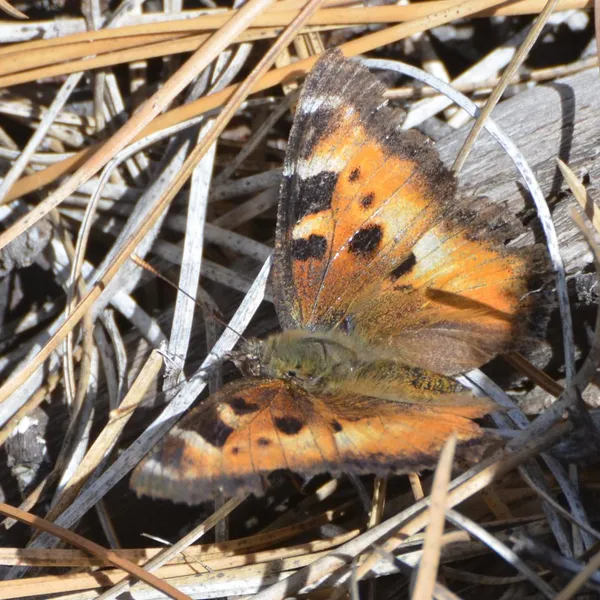
Its wings are a warm burnt orange with irregular black patches and a crisp dark border. The underside is mottled gray and brown, nearly bark-like — close the wings and this butterfly almost disappears against a log or rough surface. Like its close relative the Mourning Cloak, it overwinters as an adult, tucked into crevices and sheltered spots to wait out the cold.
Caterpillars are closely tied to native ceanothus, especially snowbrush on drier slopes and redstem ceanothus in the valley foothills. In big outbreak years, feeding caterpillars can defoliate entire hillsides of ceanothus — a dramatic sight, though the shrubs almost always recover.
Fun Facts
- In outbreak years, California Tortoiseshells can migrate in enormous numbers — waves of thousands crossing roads and covering hillsides are well-documented in Oregon.
- Like the Mourning Cloak, overwintering adults can survive nearly a year, making them among the longest-lived butterflies in the region.