
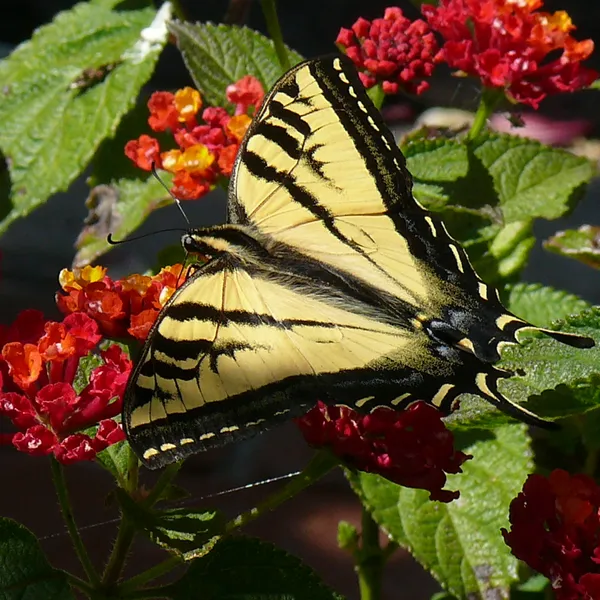
Western Tiger Swallowtail
Papilio rutulus
Adults Fly
Late May–August (peak June–July).
Eggs Laid
Late May–July (laid singly on host leaves).
Larvae Active
June–August (sometimes into September in warm years).
Overwintering
Overwinters as a pupa (chrysalis), often well-camouflaged on twigs or sheltered vegetation.
Conservation (NatureServe)
G5 (Secure)
Widespread and common; thrives where riparian trees and flowering meadows persist.
Caterpillar Host Plants (Willamette Valley natives)
- Black cottonwood Populus trichocarpa
- Scouler's willow Salix scouleriana
- Pacific willow Salix lucida ssp. lasiandra
- Oregon ash Fraxinus latifolia
- Bitter cherry Prunus emarginata
Favorite Nectar Flowers (Willamette Valley natives)
- Showy milkweed Asclepias speciosa
- Douglas aster Symphyotrichum subspicatum
- Oregon sunshine Eriophyllum lanatum
- Common yarrow Achillea millefolium
- Western red columbine Aquilegia formosa
- Canada goldenrod Solidago canadensis
What the Caterpillars Eat
Leaves of native host trees—especially cottonwood (Populus), willows (Salix), ash (Fraxinus), and bitter cherry (Prunus).
The Western Tiger Swallowtail is the butterfly that makes people stop mid-sentence. Big, yellow, and boldly striped, it’s a signature species of the Willamette Valley in late spring and early summer—especially along rivers, creeks, and leafy neighborhoods.
Caterpillars feed on native trees like black cottonwood, willows, Oregon ash, and bitter cherry. Like many swallowtails, the young caterpillars often look like bird droppings (seriously) as a form of camouflage—then later turn green and bulky as they prepare to pupate.
Adults nectar widely and often gather on damp ground for minerals (‘puddling’). If you plant natives that bloom from May through August—especially asters, milkweed, and yarrow—you’ll give them consistent fuel through their flight season.
Fun Facts
- Swallowtail caterpillars have an orange ‘osmeterium’—a little forked organ they pop out when threatened, often with a strong smell to deter predators.
- Adults frequently ‘puddle’ in groups on damp soil to gather minerals—especially males.