Back to Native Bees

Mining bees

Andrena spp.
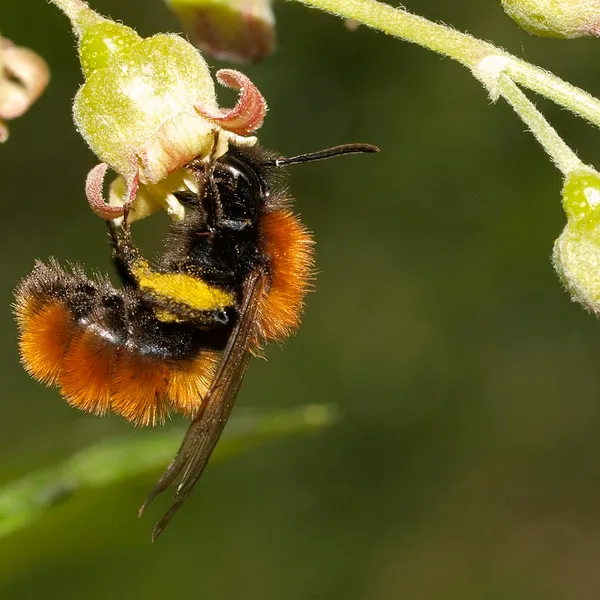
Mining bees

Nesting Preference

Solitary ground nesters; small tunnels in soil.

Active Time of Year

Often among the earliest spring bees to emerge.

Species in Genus (Oregon/Global)

100 species

Favorite Flowers

  • Salix spp. (willows)
  • Mahonia aquifolium (tall Oregon grape)
  • Camassia quamash (common camas)
  • Prunus spp. (cherries and plums)

Andrena are the spring starters, often appearing when the valley is still deciding whether it's done with winter. Because they're active early, they're especially important for pollinating early-blooming trees and shrubs, including many fruit crops.

They nest in the ground, sometimes in sizable aggregations where conditions are perfect. An Andrena nesting area can look like a tiny neighborhood of pinholes in bare soil, each entrance leading to a solitary female's careful series of brood cells.

Solitary wasp

A solitary wasp has no colony of workers helping raise her young. A female may stock her own nest cells with food, or find a host for her developing offspring. Solitary describes social life; parasitoid describes a feeding strategy. A wasp can be both.

Social wasp

Social wasps share a nest and cooperate in raising young. In yellowjacket and paper wasp colonies, reproductive females lay eggs and workers help feed the brood and maintain the nest. They can defend that nest, so observing a forager is different from approaching a colony.

Non-native Social wasp

This is a social wasp introduced beyond its natural range. In this case the European paper wasp was introduced to North America from Europe, probably hidden in shipping materials. Non-native describes its origin, while social describes colony life.