Back to Native Bees

Sweat bees (striped sweat bees)

Halictus spp.
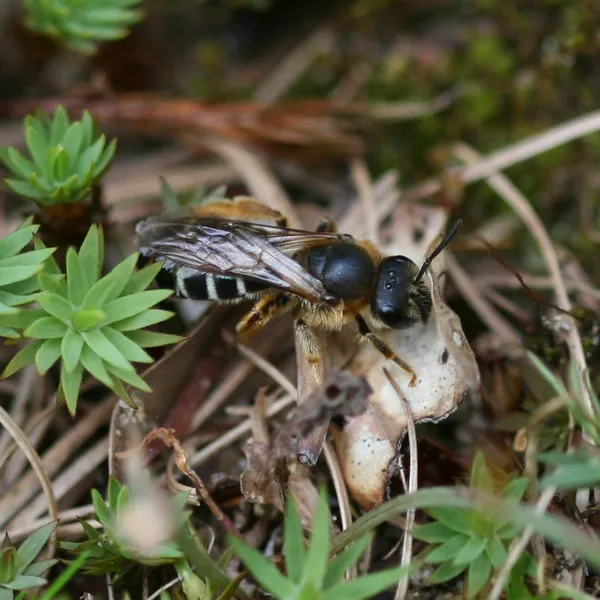
Sweat bees (striped sweat bees)

Nesting Preference

Ground nesters; tunnels in soil. Some species are partially social.

Active Time of Year

Generally spring through fall (varies by species and weather).

Species in Genus (Oregon/Global)

4 species

Favorite Flowers

  • Trifolium spp. (clovers)
  • Tagetes spp. (marigolds)
  • Zinnia elegans (zinnia)

Halictus are among the bees people most commonly overlook, right up until one lands on a flower inches from their nose. Many are dark with pale hair bands that read as subtle striping, and they're frequent visitors in both gardens and agricultural settings.

They typically nest in the ground, excavating tunnels in suitable soil. Some Halictus have social behavior that sits in the fascinating middle zone between solitary life and full-on eusocial colonies, a reminder that bee society is more of a spectrum than a binary.

Solitary wasp

A solitary wasp has no colony of workers helping raise her young. A female may stock her own nest cells with food, or find a host for her developing offspring. Solitary describes social life; parasitoid describes a feeding strategy. A wasp can be both.

Social wasp

Social wasps share a nest and cooperate in raising young. In yellowjacket and paper wasp colonies, reproductive females lay eggs and workers help feed the brood and maintain the nest. They can defend that nest, so observing a forager is different from approaching a colony.

Non-native Social wasp

This is a social wasp introduced beyond its natural range. In this case the European paper wasp was introduced to North America from Europe, probably hidden in shipping materials. Non-native describes its origin, while social describes colony life.