
Black-and-yellow Mud Dauber
Sceliphron caementarium
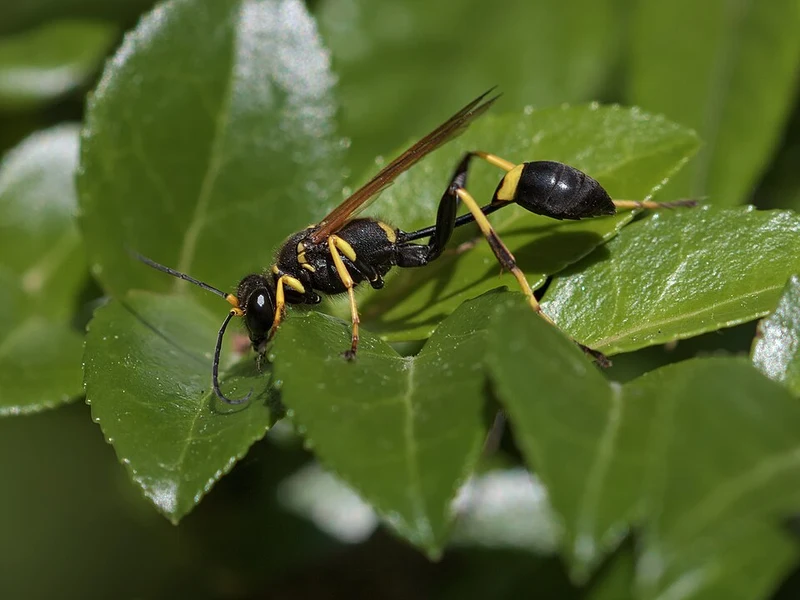
Its long, threadlike waist sets it apart from a yellowjacket. A female builds mud cells and fills them with spiders for her young. There is no defensive worker colony, though handling or trapping a wasp against skin can provoke a sting.
Building with mud
A female carries small balls of mud to a dry, sheltered spot and shapes them into brood cells. Eaves and outbuildings can offer suitable cover.
A pantry for one larva
She paralyzes spiders, stocks a cell, lays an egg, and seals it. The larva eats the stored spiders, then develops into a pupa before becoming an adult.
No worker colony
Several mud cells do not mean a yellowjacket-style colony is present. Each female provisions her own offspring. Avoid handling the wasp or trapping it against your skin.
Advice for sharing space with wasps
Learn More
Read the university identification and biology guide
Photograph & license
Black-and-yellow Mud Dauber — Kevin Krebs. CC BY 4.0. Resized and converted to WebP.
The photograph illustrates this species or group; it was not necessarily taken in Oregon.